Stop Watching Yourself Lose: The Dark Side of VOD Review Culture in Competitive Gaming
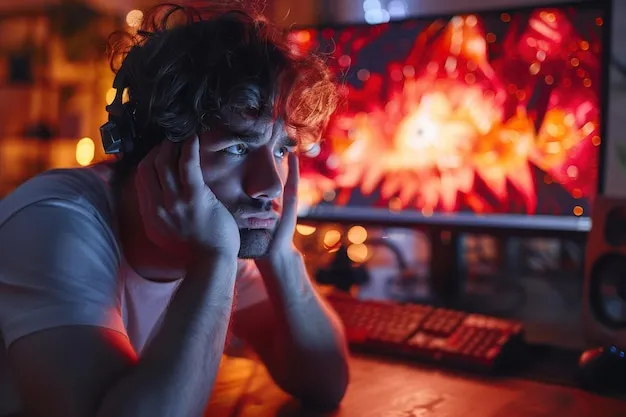
Photo: gamer frustrated watching computer screen replay esports mental performance, via img.freepik.com
Somewhere along the way, competitive gaming absorbed a piece of conventional sports wisdom and ran with it way too hard: if you want to get better, watch your replays. Review your mistakes. Analyze every decision. The pros do it, so you should too.
And look — there's truth in there. But there's also a growing population of mid-tier ranked players who are spending hours every week dissecting their own gameplay footage and somehow getting worse. More hesitant. More anxious. More stuck.
This is an opinion piece, so I'll be upfront about where I'm coming from: I think self-review culture in competitive gaming has quietly become one of the most underexamined forms of mental self-harm in the hobby, and we need to talk about it honestly.
The Promise vs. The Reality
The pitch for VOD review is compelling. Watch your replays, identify your errors, correct them, climb. It sounds like a clean feedback loop. And in professional environments with coaches, structured review sessions, and psychological support built in, it often is.
But that's not how most players experience it.
What actually happens for a lot of competitive players — especially those in that frustrating mid-tier bracket where you're good enough to know what you're doing wrong but not consistent enough to fix it fast — is something much darker. You queue. You lose. You pull up the replay. You watch yourself make the exact mistake you've been trying to fix for three weeks. You feel terrible. You watch it again. You note the timestamp. You watch it a third time. You go to bed thinking about it.
That's not analysis. That's rumination with a gaming aesthetic.
What the Psychology Actually Says
Sports psychologists have been studying this dynamic in traditional athletics for decades, and the findings translate pretty directly to esports.
Dr. Leah Simmons, a performance psychologist who has consulted with collegiate esports programs, describes what she calls "review loop syndrome" — a pattern where athletes use performance analysis as an unconscious avoidance mechanism. "They feel like they're being productive because they're engaged with their mistakes," she explained in a recent interview. "But what they're really doing is repeatedly activating the emotional memory of failure without creating any forward momentum."
The research on perfectionism in competitive contexts reinforces this. High-achieving, improvement-motivated individuals — exactly the kind of people who grind ranked modes — are disproportionately vulnerable to what psychologists call "maladaptive perfectionism": a mindset where errors aren't data points but indictments. When you review gameplay through that lens, you're not learning. You're punishing.
And punishment, it turns out, is a terrible teacher for complex motor and cognitive skills.
The Hesitation Problem
Here's where it gets really insidious for competitive players specifically.
Gaming at a high level requires fast, confident decision-making. The difference between a player who acts on instinct honed by repetition and one who second-guesses themselves in real time is massive — and it shows up clearly in rank.
When you spend hours cataloging every bad call you've made, you are literally training your brain to treat your own in-game instincts with suspicion. You start to hesitate. You start to overthink. You become, paradoxically, less decisive the more you "study."
I've talked to enough mid-level competitive players to recognize the pattern: they describe feeling like they're playing "in their head" rather than in the game. They know what they should do but can't pull the trigger. They've watched themselves fail so many times that failure feels like their default mode.
That's not a skill problem. That's a psychological wound that self-review helped create.
How the Pros Actually Use Replay — and Why It's Not What You Think
Here's the nuance that gets lost when we import pro habits into amateur contexts: professional players review footage in a completely different structure than solo players do at home.
At the pro level, VOD review is typically:
- Time-limited and intentional. Sessions have a defined scope and endpoint.
- Coach-mediated. A third party frames mistakes as correctable patterns, not character flaws.
- Separated from emotional proximity. There's usually a buffer between the loss and the review.
- Balanced with positive reinforcement. Good plays get highlighted alongside errors.
Strip all of that away, and what you're left with is a solo player alone at 1am watching themselves tilt for the fourth time in a row. That's a completely different activity wearing the same name.
Better Ways to Actually Improve
None of this means you should never watch your replays. It means you should be intentional about when, how, and why you do it.
Some alternatives that sports psychology and esports coaching both support:
Drills over dissection. Identify one specific skill you want to improve — aim consistency, resource management, map awareness — and practice it in isolation. Structured repetition builds muscle memory faster than analysis paralysis.
The 24-hour rule. Don't review a loss until at least a day after it happens. Emotional distance changes what you're able to see and how you process it.
Watch pros, not yourself. Studying how excellent players approach situations you struggle with is often more instructive than watching yourself fail at them. You're modeling success instead of cataloging failure.
Set a review time limit. If you're going to watch your own gameplay, give yourself 20 minutes maximum. Identify one thing. Write it down. Close the file. Move on.
Talk to someone. Seriously. A training partner, a coach, even a community Discord where you can get outside perspective — other eyes break the echo chamber that solo review creates.
The Bottom Line
Self-review can be a legitimate tool. But in the absence of structure, guidance, and emotional safeguards, it often becomes a way for competitive players to feel busy while quietly eroding their own confidence.
The best version of you in a ranked match is decisive, present, and trusting your reads. Hours of rewatching your worst moments doesn't build that player. It builds someone who's waiting to make the mistake they've already seen themselves make a hundred times.
Know the difference between learning from your game and torturing yourself with it. One of those moves you up the ladder. The other just keeps you in queue, dreading what you already know is coming.