Does Your Setup Actually Win Games? The Real Truth About Gear and Competitive Performance

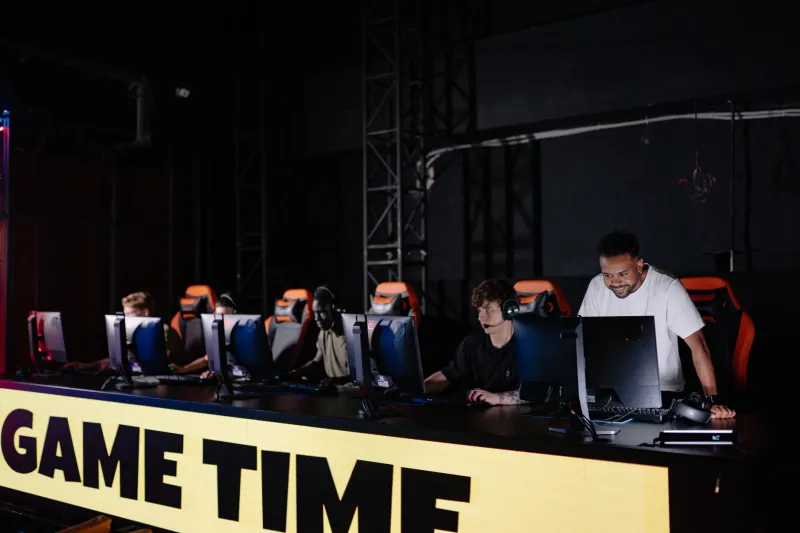
Photo by Photo by Joshua Kettle on Unsplash on Unsplash
Scroll through any gaming subreddit and you'll find the same debate happening on repeat: someone posts their modest setup, a few commenters insist they'd climb faster with a 240Hz monitor, someone else fires back that mechanics matter more than milliseconds, and the whole thing dissolves into chaos. Nobody walks away with a clear answer.
So let's actually try to give you one.
At DF999i Arena, we spend a lot of time watching competitive players at every skill tier. And the honest truth about gear is messier than either side of that argument wants to admit. It's not pure hype — but it's also nowhere near the game-changer the peripheral companies want you to think it is.
The Baseline: When Bad Gear Is Actually Holding You Back
Here's the thing nobody talks about enough: there's a floor. Below a certain hardware threshold, your equipment genuinely is costing you games.
If you're playing a fast-paced shooter on a 60Hz monitor with 20ms of input lag, you're operating in a different reality than players on smoother displays. Studies on human reaction times consistently show that input lag above roughly 100ms becomes consciously noticeable, and competitive scenarios often come down to windows far tighter than that. Running a wired mouse on a cracked mousepad that snags mid-flick? That's a real problem.
Esports coach Marcus "Drillbit" Haynes, who works with amateur teams in the Midwest, puts it plainly: "I've seen players drop two full ranks just because their peripherals were introducing inconsistency they couldn't even diagnose. They thought they were choking under pressure. Turns out their mouse sensor was stuttering."
So yes — if your gear is genuinely failing you, fixing it matters.
The Diminishing Returns Cliff
Here's where the marketing machine starts lying to you.
Once you cross a reasonable quality threshold — we're talking a 144Hz monitor, a reliable optical mouse with a decent sensor, and a mechanical keyboard — the performance gains from spending more money get very, very small, very fast.
Benchmark comparisons between mid-range and premium peripherals show measurable differences in polling rates and click latency, sure. A $150 mouse might technically click 2ms faster than a $50 one. But human reaction time averages somewhere between 150ms and 250ms depending on the stimulus. You are almost certainly not the bottleneck that 2ms is going to fix.
Pro players will tell you the same thing if you catch them off the record. "I've played on borrowed gear at LAN events that was nothing like my home setup," said one regional FPS competitor who asked to stay anonymous. "You adapt in like 20 minutes. The fundamentals don't live in the mouse."
The gear gap between a $60 setup and a $600 setup is real. The gap between a $200 setup and a $600 setup? Mostly vibes.
Where Money Actually Moves the Needle
If you've got cash to spend, here's where it actually helps — ranked by real impact:
Monitor refresh rate and response time — This is the single biggest legitimate upgrade most players can make. Going from 60Hz to 144Hz is night and day. Going from 144Hz to 240Hz is smaller but still noticeable in fast-paced titles. Going from 240Hz to 360Hz? You're paying for marginal gains that most players will never feel.
Internet connection stability — This one gets slept on constantly. A wired ethernet connection versus WiFi can eliminate packet loss and jitter that directly affects your in-game experience in ways that no peripheral upgrade can compensate for. If you're playing ranked on WiFi right now, fixing that is your highest-ROI move, full stop.
Chair and desk ergonomics — Long sessions in a bad chair create real physical fatigue. Fatigue tanks decision-making and reaction consistency. A decent ergonomic chair isn't glamorous, but it's probably worth more to your rank than a $180 mousepad.
Mouse and mousepad — A reliable optical sensor on a smooth surface matters. You don't need to spend $100+ to get there. The $40-$60 range has genuinely excellent options that pros have used to win tournaments.
Keyboard — Honestly? As long as it's mechanical and doesn't ghost inputs, you're fine. The feel matters for your comfort and consistency, so test switches when you can — but don't let anyone tell you Cherry MX Reds are the only path to Diamond.
Headset — Directional audio is real and useful in games where footsteps matter. A decent stereo headset beats cheap earbuds. Spending $200+ on a headset over a $70 option? The law of diminishing returns hits hard here.
The Confidence Variable Nobody Wants to Talk About
There's one genuinely weird reason expensive gear can sometimes help — and it has nothing to do with specs.
Placebo effect and confidence are real forces in competitive performance. If you buy a new mouse and feel like you're more locked in, you might actually play better for a while — not because the mouse is faster, but because you're approaching the game with more belief. Sports psychology research backs this up in broader athletic contexts.
That's not a reason to spend money you don't have. But it's worth acknowledging that "feeling good about your setup" has some actual value.
The Smart Upgrade Path for Competitive Players
If you're a casual-to-competitive player trying to optimize without burning your wallet, here's a practical framework:
- Audit your internet first. Go wired if you're not already.
- Check your monitor. If you're under 144Hz, that's your next purchase.
- Make sure your mouse sensor isn't garbage. Mid-range optical sensors are cheap and reliable.
- Get a flat, consistent mousepad. Cloth is fine. Big is fine. Fancy is optional.
- Stop there and actually play. Seriously. The next 500 hours of gameplay will do more for your rank than any peripheral.
The gear gap is real at the bottom. But most players reading this have already crossed the threshold where mechanics, game sense, and mental consistency are the actual levers. Spend wisely, then get back in queue.
Your rank is waiting.